Stinging insect colonies accelerate rapidly across King County from late spring through early autumn, driven by mild maritime weather patterns monitored by the National Oceanic and Atmospheric Administration .…
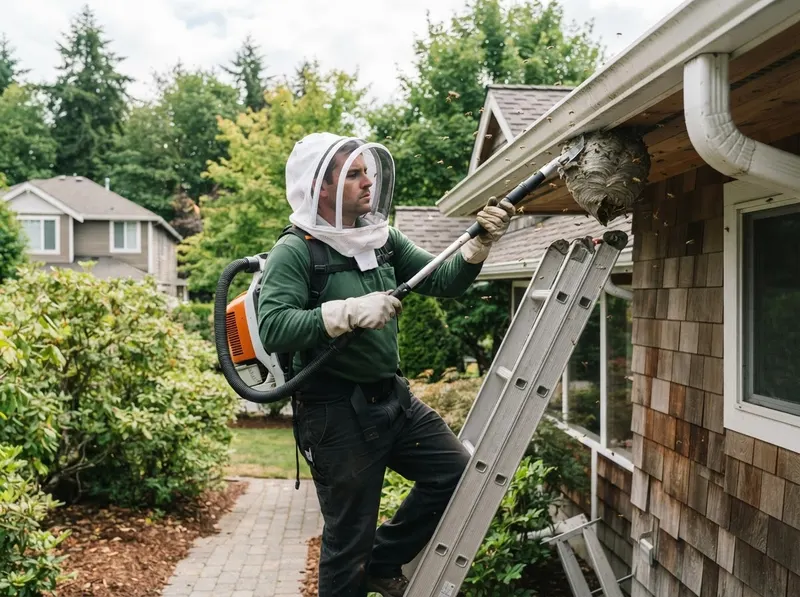
Stinging insect colonies accelerate rapidly across King County from late spring through early autumn, driven by mild maritime weather patterns monitored by the National Oceanic and Atmospheric Administration. Properties bordering dense natural reserves like the Mercer Slough Nature Park or Cougar Mountain Regional Wildland Park routinely experience high densities of western yellowjackets (Vespula pensylvanica) and bald-faced hornets (Dolichovespula maculata). For homeowners in wooded tracts such as Bridle Trails, Lakemont, and Somerset, nests frequently establish within soffit cavities, attic louvers, and subterranean rodent burrows. When foraging queens seek moisture and cellulose, standard residential construction creates accessible nesting voids unless biological exclusion standards outlined by the Washington State University Extension are implemented. Redwood Bug Services utilizes non-volatile mechanical capture and contact application protocols compliant with Environmental Protection Agency guidelines, protecting sensitive indoor microclimates from chemical saturation.
Mechanical nest extraction resolves the defensive hazard immediately, whereas unassisted pesticide spraying leaves paper envelopes and brood proteins intact behind drywall or fascia. Leaving untreated nest material in wall cavities introduces secondary dermestid beetle infestations and foul decomposition odors within 72 hours. In lakeside parcels along West Lake Sammamish and Newport Shores, high moisture retention demands botanical dust treatments and micro-encapsulated barrier barriers supported by the Washington State Department of Agriculture to prevent aquatic runoff into surface waterways. Technicians isolate structural voids using non-destructive endoscopic cameras, verifying the nesting perimeter before physical removal occurs. The entire envelope, queen, workers, and pupating comb are vacuum-extracted or structurally severed into sealed biohazard receptacles, followed by an enzymatic cleanse to dissolve aggregation pheromones.
Decision parameters balance physical extraction versus void sealing. For exposed paper wasp umbrellas hanging under the eaves of single-story residences in Crossroads or Wilburton, direct contact knockdown and mechanical removal provide immediate resolution without wall demolition. In contrast, subterranean yellowjacket nests located in decorative landscaping near Meydenbauer Bay Park or Bellevue Botanical Garden require directional non-repellent formulations that workers track directly into the central subterranean nursery. When nests penetrate interior structural spaces, protocols follow safety recommendations from the Occupational Safety and Health Administration to safely access structural framing without damaging building envelopes. Sealing weep screeds, crawlspace vents, and roof flashing with copper mesh and elastomeric sealants provides an ongoing physical deterrent against late-season re-infestation.
Every job gets a firm, written price after a free on-site visit.
For standards, safe disposal, and service guidance on PEST CONTROL SEVICE in Bellevue, WA, useful references include U.S. EPA, ENERGY STAR, U.S. Dept. of Energy, Consumer.gov, U.S. Census Bureau, and Google Maps. General consumer and small-business resources are available from USA.gov, Better Business Bureau, FTC Consumer Advice, U.S. Small Business Administration, and Ready.gov.
Tell us about your stinging insect nest removal job in Bellevue and we'll send a clear, written quote, usually the same day.
 Redwood Bug Services